Breast Cancer Survivor Credits Early Screening for Saving Her Life
Published Oct. 30, 2024 | Last updated Oct. 6, 2026
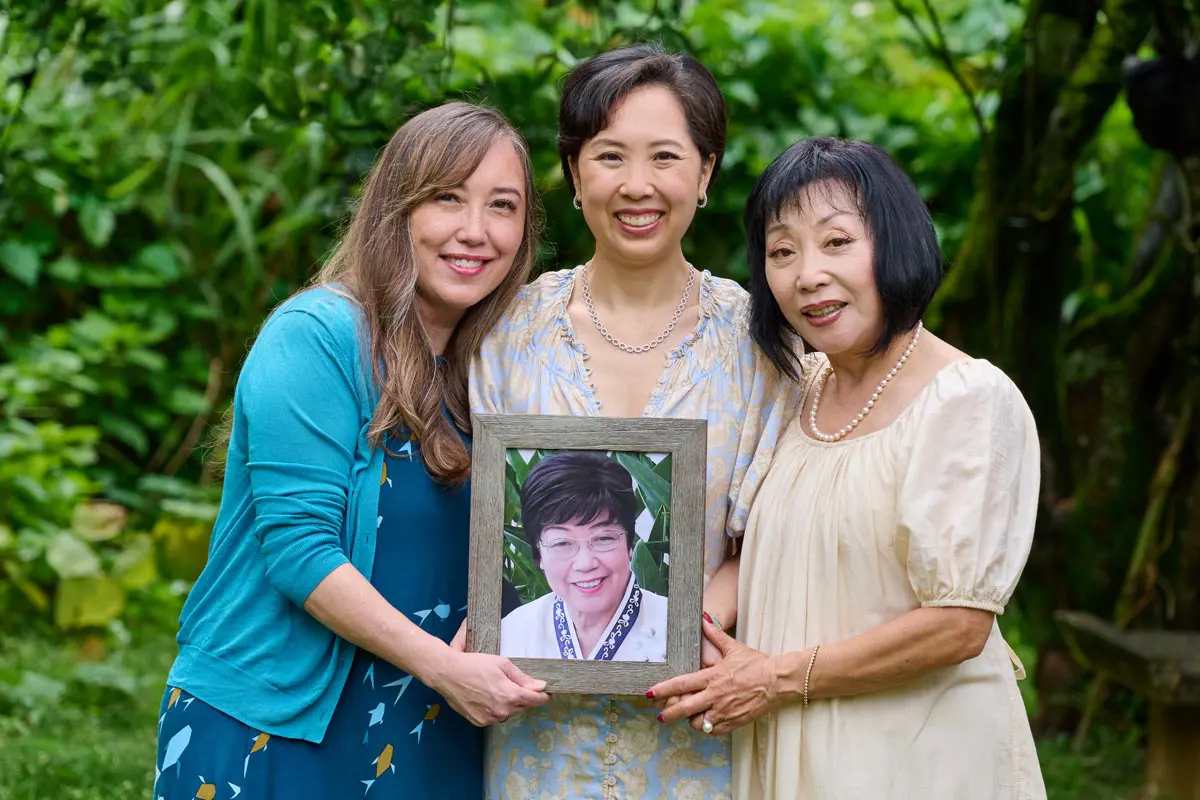
As a third-generation breast cancer survivor, Anj Oto (center, seen here with her sister, left, and their mother, holding a photo of her grandmother) stresses the importance of knowing your family health history and early health screenings.
The year 2020 was a pivotal time for Andrea “Anj” Oto, and not for the reason many would think.
The Honolulu native had just gotten married, and she and her husband, Eric, were trying to start a family.
“The pandemic gave me perspective to focus on my health. I had gotten off birth control and other medications and had been on my own health journey to eliminate toxins and preservatives,” Anj shares.
Part of that journey also involved having her first screening mammogram at age 30.
“Because I have a family history, I was cleared to start annual mammograms early,” she shares.
Anj’s mother had been diagnosed in her late 30s, and her grandmother in her 60s. It was during her annual screening in 2022 that Anj learned she would follow this family line when she received a diagnosis of Stage 0 Ductal Carcinoma in Situ (DCIS) breast cancer.
Anj was 33 years old.
Lifesaving Power of Early Breast Cancer Detection
“I always knew I had a risk of breast cancer but never thought it would happen as soon as it did,” Anj confesses. “When I was diagnosed, I felt I was the healthiest I had ever been. I was exercising and eating healthy, so it came as a surprise.”
After being diagnosed, she underwent a lumpectomy to remove the cancerous calcifications. As a result of the surgery, her pathologist found that she also had Invasive Ductal Carcinoma (IDC) cells, which advanced her diagnosis to Stage 1, ER+ (estrogen receptor positive), HER2+ (human epidermal growth factor receptor 2 positive) breast cancer.
HER2 is a protein that promotes the growth of cancer cells, making cancer a lot more aggressive.
“Because we were trying to conceive and we didn’t know what treatment would involve, I first did a round of invitro fertilization with Dr. Thomas Kosasa,” Anj shares, adding, “Looking back, if I had successfully gotten pregnant, my body would have produced an influx of estrogen hormones, thus activating my estrogen-responsive cancer cells. That, combined with the HER2 proteins, would have put cancer on a fast track to metastasis.”
Support from a Dedicated Cancer Care Team
Following her new diagnosis, Anj started chemotherapy at Kapiʻolani Medical Center for Women & Children in February 2023. The three-month treatment entailed weekly rounds of chemo, blood draws, and follow-up appointments.
“While I was in chemo, I also received a treatment called Herceptin, which targets the HER2 protein. It was 14 treatments, similar to chemo where you need to sit in a chair for treatment. I had a month-long break before starting radiation,” Anj recalls.
Throughout her treatment, Anj relied heavily on family and friends for physical and mental support.
“I was very fortunate that I never went to chemo alone – I had a family member or a friend with me. I would get sick a lot and had to ice my mouth, hands, and feet during each treatment, so having someone to assist me and drive me was very helpful,” she says, adding that her care team also provided much-needed support during this time.
“Dr. Michelle Miyashiro, my oncologist, was very helpful, as was my nurse practitioner, Tracey,” Anj says. “You see the same nurses every week, so they were all very supportive, along with the medical assistant and patient navigators at the cancer clinic.”
However, side effects due to the treatment began to weigh heavily on Anj.
“I was pretty depressed toward the end of chemo,” she says. “I had so many side effects – I lost a lot of weight, couldn’t eat much, and the fatigue was pretty bad. I would beg my husband, saying that I didn’t want to go to chemo.”
Finding Strength in a Community of Survivors
It was during this time that Anj began sharing her story on social media.
“I felt so much less alone and was able to get out of that funk. Connecting with other patients and survivors helped improve my mental health significantly,” she shared.
Anj maintains her Instagram page (@onwardwithanj) and started a Substack account (OnwardwithAanj.Substack.com) as well. She even hosted a meetup in summer 2024 for other Hawaiʻi cancer “survivors and thrivers” to get together IRL (in real life).
“I’ve become very close with several patients via social media, and it was rewarding to meet them in person. They continue to be a big source of connection and community for me,” she said.
Anj completed cancer treatment in March 2024.
“I’m on the road to recovery,” she says. “Healing takes time, and my body has been through quite a lot in the past year. Right now, I’m just focusing on healing my mind and my body.”
Part of her healing journey includes physical therapy at the Kapiʻolani Women’s Center to support her mobility and chronic pain from surgery.
She also is now on maintenance medications, which entail their own set of side effects, but Anj remains steadfast in her mission to serve as a lighthouse for others going through the storms of cancer.
Essential Screening and Self-Checks for Those at Risk
“If you have a family history or are aware of a genetic mutation, consult with your care team or doctor to see if you can receive early screening or be part of Kapiʻolani’s high-risk program,” Anj advises. “Regardless, make sure you are doing your monthly self-checks and are prioritizing annual appointments with all of your doctors, whether that be getting a skin check with a dermatologist or seeing your OB-GYN for a pap smear.
“I try to change the status quo by sharing my story and normalize talking about the more uncomfortable things – even things like family history, something we don’t always talk about,” she says. “I truly believe knowing my family history and early detection saved my life, because this type of cancer you couldn’t see or feel.
“Know your body so that you can notice any changes,” she added. “Breast cancer can show up in many different ways. If you notice anything that seems different or seems off, be sure to let your doctor know. It’s important for people to prioritize their health, because the earlier they catch it, the more treatable it is, even if it’s an aggressive type of cancer like I had.”
"How Early Detection Saved My Life"
Anj shares more about her journey, how early detection can make a difference, and how she's doing today in the video below.
View transcript
ERIC OTO: What made me fall in love with Anj? She's a beautiful person inside and outside.
ANJ OTO: Eric and I got married in 2020, and we had been trying to conceive for a couple of months when I went in for my annual mammogram. That mammogram led to two biopsies, and that was how I was diagnosed with breast cancer.
WENSHENG TRACY WU, NP: Andrea was diagnosed with early-stage breast cancer. It was hormone receptor positive and HER2 receptor positive, which is an aggressive subtype of breast cancer.
ANJ OTO: I have a family history of breast cancer. My maternal grandmother was diagnosed in her 60s. My mom was also diagnosed with breast cancer in her late 30s.
BETTY TAMAYO, ANJ's SISTER: I was very scared, knowing that our grandmother did die from breast cancer. It was very frightening to know that my baby sister was going to have to now go through the same journey.
DR. JAMI FUKUI: It's always hard to see situations like Anj has gone through. We really try hard to detect breast cancer early. Because of family history, there was already some understanding of what to expect. Unfortunately, we needed to give very aggressive treatment for a more aggressive type of breast cancer, which included not only surgery, but chemotherapy.
ANJ OTO: Going through chemo was the hardest thing I've ever done in my entire life. It impacted me so much physically, but also mentally, too. I honestly just felt really down and really depressed towards the end of chemo because it had just been week after week of dealing with these side effects.
ERIC OTO: It was super difficult to see someone you love and care for so much go through that. And what killed me was when I would see people there by themselves, without family, without friends. I couldn't imagine going through that without that support.
ANJ OTO: Just before my second-to-last chemo, I started an Instagram page where I shared some tips on how to navigate side effects, on what to bring with you to chemo, and that quickly morphed into a community of survivors, and thrivers, and previvors on social media.
DR. JAMI FUKUI: We really appreciate Anj sharing her story. It's a very brave thing to do, and it opens up so many doors for other people who are going through the similar thing.
BETTY TAMAYO: As we were discussing the course of her treatment and when she was nearing the end, we talked about different ways of celebrating.
ANJ OTO: So a lot of people in cancer clinics around the world, when they complete treatment, they will ring a bell.
BETTY TAMAYO: As she exited from her last treatment, we were able to present her the bell that I donated to the cancer center.
[Anj rings bell as providers and friends cheer.]
DR. JAMI FUKUI: After all these treatments that she received, she is now cancer-free.
ANJ OTO: I can't imagine going through treatment and getting care anywhere else. I truly believe that I have the best care team in the universe.
DR. JAMI FUKUI: Anj's story really helps to showcase how important it is to have early detection and screening, and sometimes in a high-risk program. It's important to understand your health, your family history, and really tailor treatments and management according to that.
ANJ OTO: I truly believe that early detection saved my life. If it were not for that mammogram at Kapiʻolani, I don't know where I would be today, but it certainly would not be where I am right now.
Schedule your mammogram today.
As a third-generation breast cancer survivor, Anj Oto stresses the importance of knowing your family health history and early health screenings.


