Advanced Technology is Changing Lung Cancer Diagnosis and Treatment
Published Nov. 13, 2026
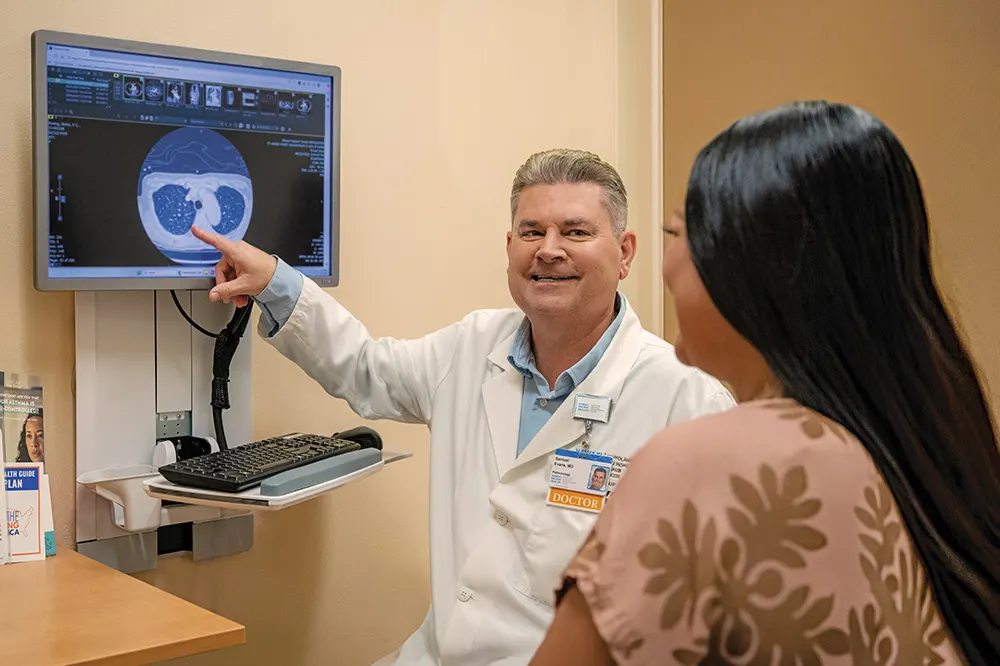
Dr. Sam Evans reviews a lung scan with a patient and discusses the findings.
Finding lung cancer early can make an important difference in treatment, and advances in screening and diagnostic technology are helping physicians detect the disease earlier and more precisely.
Dr. Samuel Evans, a Hawaiʻi Pacific Health Medical Group pulmonologist and chief of staff of Straub Benioff Medical Center, explains who should be screened for lung cancer, how tools such as the Ion robotic platform are improving diagnosis, and how treatment continues to evolve.
Why is early screening essential for diagnosing lung cancer?
The lungs don’t have pain receptors, so patients often do not experience symptoms until the cancer has spread and is at a more serious stage. The earlier lung cancer is caught, the better chance we have of curing it.
Patients aged 50 to 80 with at least a 20 pack-year smoking history who smoke or have quit within the past 15 years should be screened annually. A pack-year equals the number of packs smoked daily multiplied by years smoked.
Screenings are usually painless, fast, and utilize low doses of radiation.
What are the benefits of the Ion robotic platform?
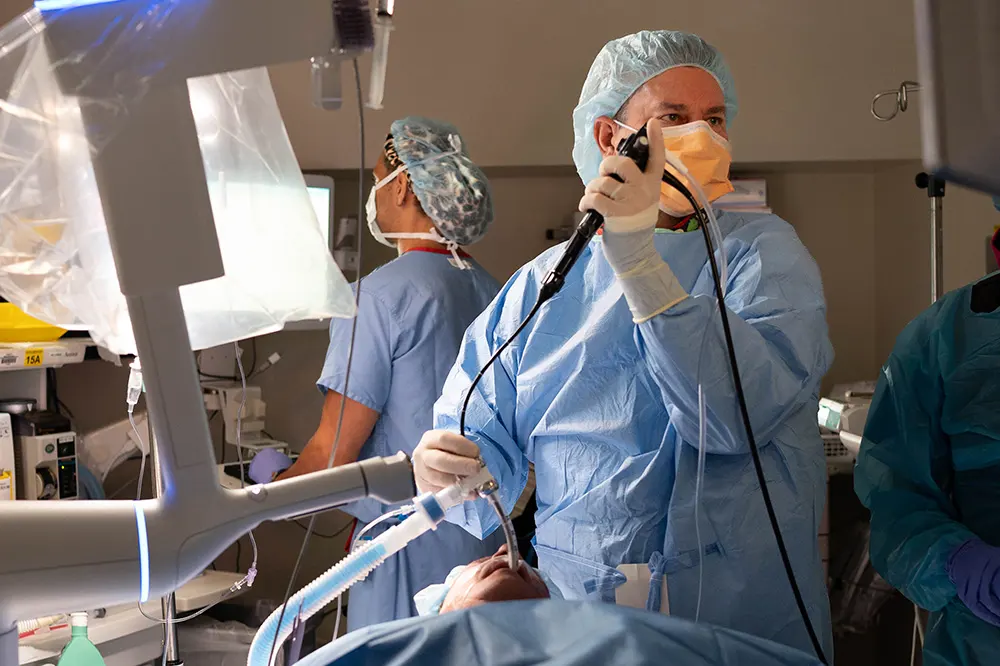
Two pulmonologists at Pali Momi Medical Center and three at Straub Benioff Medical Center perform Ion procedures nearly every day.
We can precisely biopsy nodules as small as 8 millimeters, or even smaller with cone-beam computed tomography, where a cone-shaped X-ray beam creates detailed 3D images. This allows us to investigate smaller lesions during the procedure so we can be confident we are sampling the suspect lesion.
Ion biopsies are safer than traditional biopsies that often involved inserting a needle through the chest wall into the lung. Ion biopsies are painless. Patients are asleep during the procedure, which typically takes about an hour, and most go home the same day.
What are the latest treatments for lung cancer?
Lung cancer treatments have advanced greatly over the past decade. Traditional chemotherapy, radiation, and surgery are still used. However, we now have targeted therapies, medications targeting genetic mutations that drive the cancer. Immunotherapies activate the patient’s immune system against cancer cells.
On the horizon is mRNA vaccine technology, which teaches patients’ cytotoxic T cells, which are immune cells, and natural killer cells to attack lung cancer cells. Researchers are looking into localized treatments for early-stage cancer that can be applied during an Ion biopsy.
How do specialists work together when a suspicious lung nodule is detected?
Our multidisciplinary team approach starts the moment we detect a nodule. Radiologists and pulmonologists work together to assess the nodule and decide if it should be monitored or needs to be biopsied. Sometimes a blood test can help determine if a nodule is more likely to be benign or malignant.
Positron emission tomography (PET) scans can show how metabolically active a nodule is, which helps us identify benign versus worrisome lesions and guides us to the best location to biopsy when multiple areas are suspicious.
During Ion procedures, pathologists examine our biopsies in real time and tell us when we have enough tissue to establish the diagnosis. While the patient is asleep, we will also take samples of lymph nodes to check if the cancer has spread.
If lung cancer is diagnosed, the patient’s information will be reviewed by our tumor board – different specialists who meet regularly for multidisciplinary discussions of cases. Together, we review the guidelines and determine the best approach for treatment, including medication, surgery, radiation, or a combination of care options.
Today, lung cancer surgery is also performed with minimally invasive robotic technology, allowing for faster recovery times and shorter hospital stays.
How can people lower their risk for lung cancer?
If you don’t smoke, don’t start. If you do smoke, quit or cut back. Avoid secondhand smoke. Avoid toxic substances like asbestos, arsenic, uranium, radon gas, or diesel exhaust. Eat healthy and exercise! Most importantly, if you meet the criteria, get screened for lung cancer annually.
This article was first featured in the Oct. 28, 2026, issue of MidWeek as a part of the “Dr. in the House” series. See the full publication.


