Diane Ching, MD
Pediatrics
The Kapiʻolani Cleft and Craniofacial Center (KCCC) is the major referral center in Hawaiʻi for cleft and craniofacial related problems. Not only do we treat the majority of children with cleft and craniofacial related conditions in the state, but children travel from Guam, American Samoa and Micronesia to receive care at Kapiʻolani.
Kapiʻolani Cleft and Craniofacial Center is one of the approved American Cleft and Craniofacial Association teams, which provides a standard for team care. It is widely known that children born with clefts and craniofacial conditions are best managed by a multidisciplinary team to provide complex and specialized care in a coordinated team environment. Our experienced team of surgeons and providers at the Kapiʻolani Cleft and Craniofacial Center individualizes current and long term treatment plans for each child.
The mission of the Kapiʻolani Cleft and Craniofacial Center is to provide each child born with a cleft or craniofacial condition with exemplary family centered care so that he/she will have the same opportunities in life as any other child.
Kapiʻolani's Cleft and Craniofacial specialists have been transforming the face of children's health, one smile at a time. See images of real patients below:
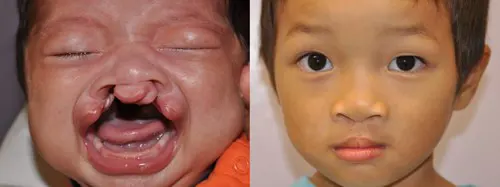
Cleft Palate (surgeon: Dr. David Cho)
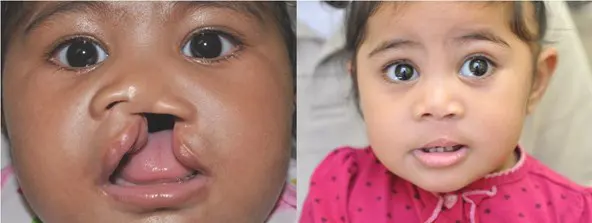
Cleft Palate (surgeon: Dr. David Cho)
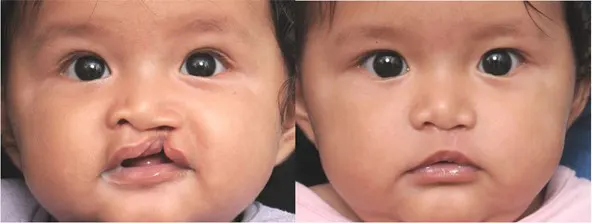
Cleft Palate (surgeon: Dr. David Cho)
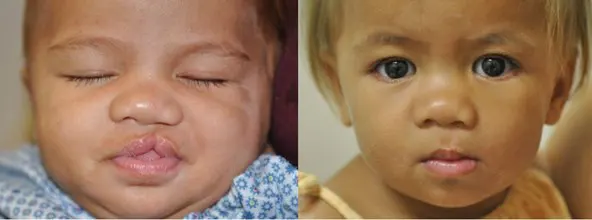
Cleft Palate (surgeon: Dr. David Cho)
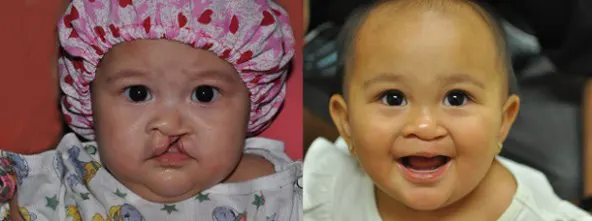
Cleft Palate (surgeon: Dr. David Cho)
We treat cleft and craniofacial conditions of the head and face including but not limited to conditions such as a cleft lip, cleft palate, craniosynostosis and microtia.
A cleft lip is a separation in the upper lip and cleft palate is a hole in the roof of the mouth. They are some of the most common birth anomalies found in the United States.
Craniosynostosis is a condition in which the bones of the baby’s head fuse too early. This condition requires management and treatment by a Craniofacial surgeon.
Microtia is the underdevelopment of the ear and atresia is the underdevelopment of the ear canal which can cause hearing problems.
While clefts are the most common type, various other conditions can occur. Conditions treated at Kapiʻolani include:
Employing a multidisciplinary approach, the dedicated team of specialists works to provide a comprehensive plan of care for the long-term health of each child. A team-based multidisciplinary approach is the best way to recognize and treat the full spectrum of challenges associated with cleft and craniofacial conditions, including dental, hearing, speech and psychosocial concerns.
Members of the Kapiolani Cleft and Craniofacial Team include:
By Referral:
Your child’s primary physician can make a referral to KCCC before your baby leaves the hospital or after discharge. This should be done by contacting Kapiʻolani Cleft and Craniofacial Center (KCCC) at (808) 983-8500, option 1. Neighbor island residents may call toll free at (866) 928-7927.
Patients are seen in the Multidisciplinary Clinics on the 3rd floor of the Diamond Head Tower. These visits can take between 2-4 hours. During the team appointment, your child will see specific specialists. There may be team members who do not examine your child at every visit but who still offer expert consultation or advice during the team conference. The benefit of arranging a team visit is that a patient will be provided with a comprehensive, coordinated care plan in one visit rather than multiple visits with different providers.
Parents and the child’s primary physician will receive a copy of the team report and plan of care. Parents are encouraged to discuss the plan with their child’s doctor.
At the Kapiʻolani Cleft and Craniofacial Center (KCCC), our goal is to implement a specialized care plan for each child with a cleft or craniofacial condition. We are here to assist with timely appointments and ongoing coordination of care until each child reaches young adulthood.
Your child’s primary care physician can make a referral to the center before your baby leaves the medical center or after discharge. This should be done by contacting Kapiʻolani Cleft and Craniofacial Center at 808-983-8500, option 1. Neighbor island residents may call toll-free at 866-928-7927.
Pediatrics
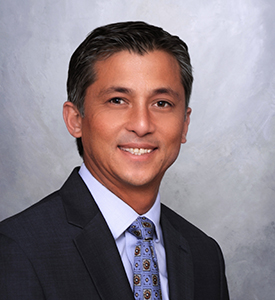
Plastic Surgery
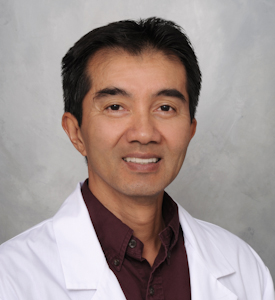
Plastic and Reconstructive Surgery, Plastic Surgery
APRN - Behavioral Health
Oral & Maxillofacial Surgery
Oral & Maxillofacial Surgery
Pediatrics

Plastic Surgery
General Dentistry
Yes, prenatal consults are available. Please call 983-8500, Option #1 to schedule an appointment.
Team days are Friday mornings. Each Friday may have a different set of specialists. The appointment date will be based on the individualized needs of your child.
After your appointment, your specialists will meet to discuss the team recommendations and a letter summarizing your visit will be mailed to you and your child’s primary care provider.
This will depend on the specific needs of your child. For newborn children, it may be as frequent as weekly to work on feeding and weight gain. For the older child, it may be a yearly visit to monitor timing for the alveolar bone graft.
Your child’s primary care doctor can assist with your travel to Oʻahu. We can work with your child’s doctor to help coordinate appointments while on Oʻahu.
Some conditions or syndromes treated at KCCC may have a genetic component. We have a genetics team (geneticist and genetic counselors) to work with you and your child. The genetics team can meet with you and your child during your team appointment.
Optimal surgery times can vary with each child. In general, cleft lip is repaired at age 3-5 months old and cleft palate at age 9-14 months old.
For questions on microtia or craniosynostosis surgery timeframes, it will depend on the surgical procedure and the individual child. Please call 983-8500, #1 for an appointment.
For children born with microtia (underdevelopment of the ear), a cleft lip (gap in the lip), or a cleft palate (gap in the roof of the mouth), surgery is considered reconstructive for this congenital anomaly and should be covered. Please call us or your insurance company for specific questions.
Every individual child is different. Babies with a cleft palate have difficulty creating enough suction and may have a hard time pulling milk through a regular bottle. They usually need to use a specialty bottle. Milk flows through the specialty bottle/nipple when the baby’s tongue pushes on the nipple. Our team of feeding specialists will work with you and your child to find the feeding method that works best for your baby.
Bottles can be purchased online or may be covered by insurance. We will give you the information you need to receive bottles based on which bottle is best for your baby.
Orthodontics for children born with a cleft or born with an orofacial anomaly is not considered cosmetic. It may improve function or may be a part of the long term treatment plan for medical or surgical management.
Legislation was passed in Hawaiʻi in July 2015 that requires mandatory orthodontic coverage for children born with a cleft or orofacial condition.
Please call us at 983-8500, # 1, to discuss specific concerns.
You and your child’s primary care provider will receive a letter summarizing the team recommendations. You can share the recommendations with your child’s care team such as his/her early intervention provider, speech therapist, public health nurse, school teacher, dentist, orthodontist, and oral surgeon.
We believe in collaborating with the family and the child’s care team within your community in order for us to achieve optimal outcomes for your child.
Please call us at 983-8500, #1 if you have any questions about the team recommendations or how you can best advocate for your child.