
Kaila Wada

Published March 15, 2019
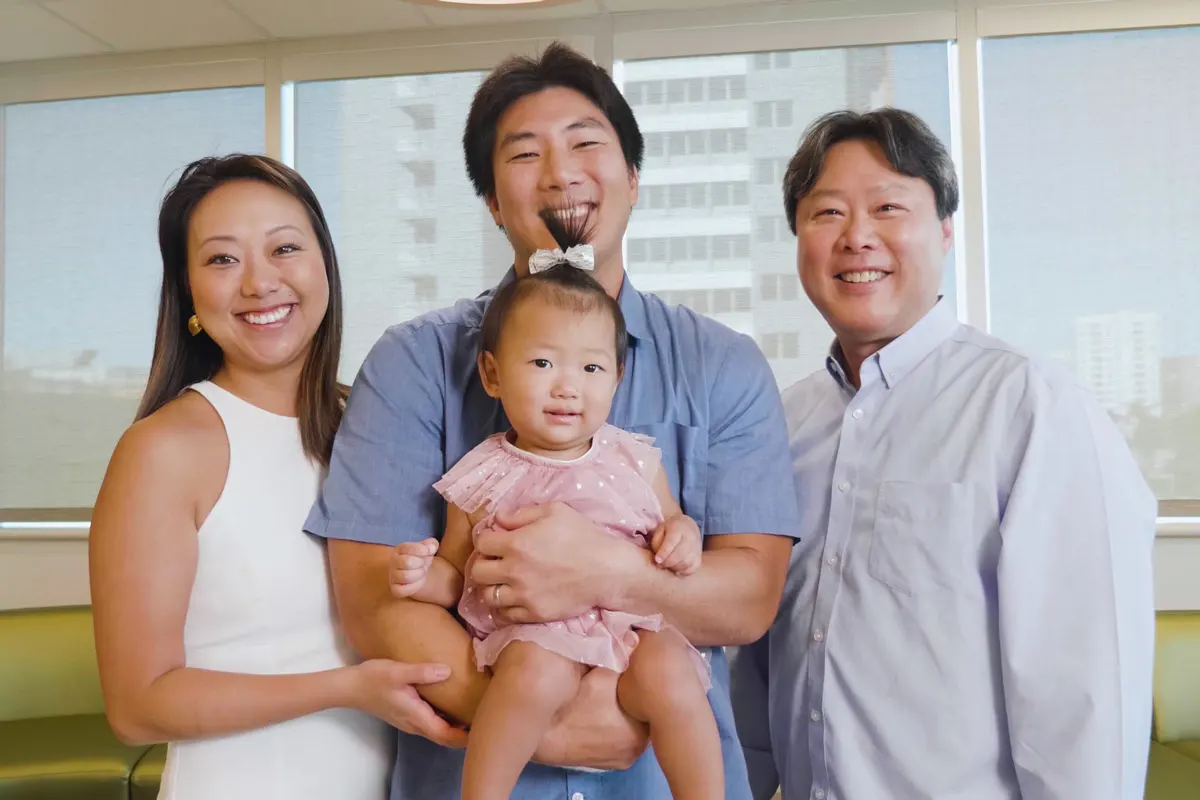
Little girl smiling with her father, mother and grandfather.

Karen and Robert Wada had enjoyed a healthy pregnancy. But when Karen was ready to give birth at Kapiʻolani Medical Center for Women & Children, her baby was in distress and needed to be delivered via emergency C-section.

That was only the beginning of little Kaila’s long health journey.

After she was born, Kaila looked pale and wasn’t doing well.

At first, she was diagnosed with meconium aspiration syndrome, a condition that occurs when fecal material enters the baby’s lungs due to stress upon or before delivery.

Then, doctors gave Karen and Robert the news that Kaila had experienced a type of brain damage called hypoxic ischemic encephalopathy, which meant Kaila’s brain wasn’t receiving enough oxygen and blood.

Kapiʻolani could treat Kaila’s condition and save her life with a machine called extracorporeal membrane oxygenation (ECMO).

Although there were some risks involved, and the treatment would be a long process, this was their only hope. Robert’s dad, Kapiʻolani Pediatric Oncologist-Hematologist Dr. Randal Wada, convinced them to place Kaila on the ECMO machine and trust the Kapiʻolani team of specialists.

Karen and Robert were involved in the ECMO treatment rounds each day and understood the magnitude of their daughter’s critical status. Kaila’s progress was slow but steady.

Within five weeks, Kaila completed her ECMO treatment and slowly was weaned off the respiratory system and morphine.

After multiple follow-up visits with therapists and neurologists, Kaila is a happy, healthy and normal toddler.

She will be celebrating her second birthday this year.


Watch Kaila's full story unfold in the video below.

View transcript
My pregnancy was very very smooth. All of the ultrasounds, the follow-ups, everything expecting to be a very healthy baby.
From the moment we got into the hospital, but we were both very excited you know I had just rushed from work to get in there she was already there set up you know they had started inducing her she was happy taking selfies and you know just being really cheerful and it was an exciting mood.
As they started inducing me, I wasn't dilating I got a fever all of a sudden.
They actually had to talk to us about possibly getting a c-section
This c-section discussion happened and then they said actually we have to go right now.
When we go to these c-sections it's usually because the baby inside the mom is having difficulty and the OBY were worried about it.
They got her out and I thought it was a little bit strange she seemed a little pale to me, but I've never seen babies before, so I don't know.
It's just that once they cut the cord away from mama, Kaila became very sick it was really obvious she was very dependent on her mama.
I mean, he brought Kyla to me and said well you know he wouldn't let me hold her or anything like that but it sounded like look we have to you kiss her that we have to go kind of sense of urgency.
Kyla was not taking care of her airway, and she needed an airway, so I unfortunately had to put a tube down her in order to breathe for her. Sometimes when babies are very sick the body itself starts to want to revert back to how it was when it was inside the mom, we call it a fetal circulation, and she started reverting back that way. The blood pressure and her lungs went very high it was hard for her heart to pump blood into her lungs and put her on a special ventilator called an oscillator she was on just maximum maximal support.
The final one that was really hard was ultimately they came back and said, "Okay, ventilators aren't going to work. We're maxing out the settings on that and we will need to try something else, something called ECMO."
There was really no choice you know it was these are all the risks but if not she's not going to make it. This is the last chance for her survival.
Robert actually called us and he said that despite all the things they were doing for her, her lungs were continuing to worsen and so they needed to meet with them to talk about the possibility of having to put her on pulmonary bypass. It's called ECMO which stands for extracorporeal membrane oxygenation and I think the next thing I felt was relief because these people know what they're doing. I work with them on a day-to-day basis and I trust them with her.
Kaila had meconium aspiration and had a little bit of a difficult delivery, and she was put on ECMO and she did amazingly well.
The day that she was coming off of ECMO I was so excited.
One of the exciting moments you know in the whole process of weaning her off from the ECMO is witnessing her first actual breath. As that expectant parent, you're excited to take all these you know videos and  pictures I didn't expect to be taking a video of her first breath.
 [Video of Kaila's first breath plays] 
When she got off, she did great. It was like clockwork after that. We thought she was gonna go home on oxygen and Kaila proved us wrong again, she went home on room air. Her getting home so soon wasn't just because of us. It was because of many many people that were involved. Respiratory therapists were very important helping us to get her off of the ventilators and this would have never happened without lactation consultants.
So human milk we know is the best thing for our babies. But in the NICU, human milk is even more important. it's almost like medicine for them. 
Overall, it's a real comprehensive teamwork of not just medical but your emotional, spiritual, and they have built an amazing foundation for every family to succeed.
That's why this hospital is here, that's why these programs are here They're being done not because it makes sense financially but because it's part of what this hospital does.
Parents never lose hope, and we as physicians should never lose hope and I think the whole type of technologies and type of resources that we have available to us at Kapiʻolani so we can save lives like this provide that hope.
[Music]

When complications during birth required little Kaila Wada be placed on the ECMO machine for the first five weeks of her life, her parents put their hope and trust in the team of specialists at Kapiʻolani Medical Center.