Changing the Outlook for Lung Cancer Through Earlier Detection
Published April 30, 2026
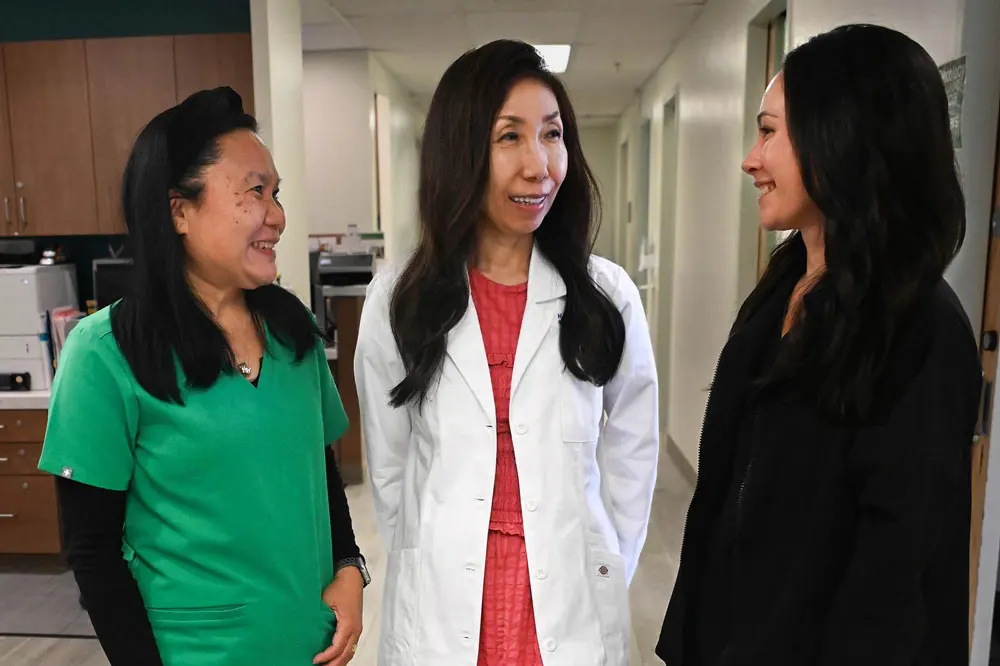
Dr. Lori Pai (center) talks with Straub Benioff oncology medical assistant Diana Ronquillo (left) and pharmacist Sabine Sonomura.
Key Takeaways
- Screening can find lung cancer earlier, when treatment may be more effective. Talk with your doctor about your risk and whether annual screening is right for you.
- Early detection can greatly improve survival. Lung cancer found at an earlier stage generally has a much better outlook.
- Genetic testing helps personalize treatment. Results can guide doctors to targeted therapies or immunotherapy based on each person’s cancer.
- A team approach supports complex care. Specialists work together to develop a comprehensive treatment plan for each patient.
Lung cancer is the leading cause of cancer deaths in Hawaiʻi and the United States. However, Hawaiʻi’s early diagnosis rates are the lowest in the nation at 21.8%, notes Dr. Lori Pai, a Hawaiʻi Pacific Health Medical Group hematologist and oncologist based at Straub Benioff Medical Center.
Dr. Pai is one of the only lung cancer specialists in the state. She received her medical degree from Harvard Medical School, then completed an internship and residency in Internal Medicine and a fellowship in hematology/oncology.
Dr. Pai was an assistant professor at Tufts University School of Medicine and associate director of the school’s hematology and oncology fellowship program. She was one of Castle Connolly’s Top Doctors in Boston in 2024 and 2025.
Here, Dr. Pai explains more about the importance of early diagnosis and her work treating complex cases.
What are the challenges for early diagnosis of lung cancer?
The main challenge is that not enough people are actually getting screened. Less than 20% of those who qualify for a screening in the U.S. are up to date.
Active and past smokers are at higher risk of lung cancer. Current guidelines recommend annual screening with low-dose computed tomography for adults aged 50-80 years who have at least a 20 pack-year smoking history and smoke or have quit within the past 15 years. A pack year is calculated by multiplying how many packs a person smoked daily by the number of years smoked.
Females of Asian ethnicity who have never smoked have a significantly elevated risk for lung cancer. This is increasingly recognized as an important cancer health disparity, but they are not included in screening recommendations.
If you have any questions or concerns, talk with your physician.
Why is it important to catch lung cancer early?
The survival rate is much higher if you are diagnosed earlier. The five-year survival rate for Stage 1 lung cancer is approximately 65%-80%, compared to roughly 13%-25% for Stage 3.
How have lung cancer treatments changed?
Early stage lung cancer is typically treated with surgery, radiation, or a combination of chemotherapy and radiation.
The treatment of late-stage or metastatic lung cancer has undergone a paradigm shift that has more than doubled the survival rates for many.
Ten years ago, platinum-based doublet chemotherapy was the backbone of treating all metastatic lung cancer. Chemotherapy, however, does not distinguish between cancerous and healthy cells.
Now, we focus on genetic testing at diagnosis. With this information, we can direct patients to the most appropriate individualized treatment.
Targeted therapies are personalized drug therapies that target genetic mutations that encourage cancer cell growth, all while minimizing damage to healthy cells. Immunotherapy monotherapy utilizes a specific drug to block proteins that essentially inactivate a person’s T-cells, which are white blood cells in the immune system. Immunotherapy helps ensure the T-cells can continue attacking cancer cells. Platinum-based chemotherapy is still also used in combination with medications.
Treatments continue to evolve, with newer agents that deliver drugs directly to cancer cells and spare healthy cells.
What is involved in managing complex cases?
At Hawaiʻi Pacific Health, complex cases are managed through our multidisciplinary thoracic tumor board. This team of doctors includes thoracic surgeons, pulmonologists, pathologists, radiologists, radiation oncologists, and oncologists. We convene regularly to review challenging cases, look at images and pathology slides, and share opinions from each specialty to create a comprehensive treatment plan for each patient.
What do you like most about your job?
I am intrigued by the science of cancer biology. There are still so many unanswered questions in the field of oncology, which keeps me motivated to push science forward with clinical trials for lung cancer.
I am also eagerly looking forward to mentoring Hawaiʻi’s future oncologists through an upcoming fellowship program.
Most of all, I really enjoy the relationships with my patients and helping them through difficult treatments and decisions.
This article was first featured in the April 29, 2026, issue of MidWeek as a part of the “Dr. in the House” series. See the full publication.


