Pulmonology (Respiratory Health)
Stay connected to your care with MyChart® by Hawai‘i Pacific Health – message your provider, view test results, complete forms, and more.
Service Overview
Pulmonology addresses conditions that affect your chest and lungs.
Infections, asthma, cystic fibrosis, emphysema and lung disease can leave you breathless. Many heart conditions can affect your breathing and your lungs, too.
Whether a cold may have turned into bronchitis, or you need relief from a condition like asthma, our pulmonary specialists can help.
Conditions & Treatments
As an organization, here are some of the pulmonary conditions we treat:
- Acidosis
- Acute and chronic pulmonary embolisms
- Alkalosis
- Asthma
- Bronchiectasis
- Bronchitis
- Central Airway Obstruction (CAO)
- Chronic pulmonary heart diseases (including pulmonary hypertension)
- Collapsed lung (pneumothorax)
- COPD (Chronic Obstructive Pulmonary Disease)
- Cystic fibrosis
- Duchenne muscular dystrophy
- Emphysema, including lung volume reduction surgery
- Empyema
- Evaluation of shortness of breath
- Fungal infections of the lung
- Granulomatous lung diseases
- Hepatopulmonary syndrome
- Interstitial lung disease
- Lung cancer
- Lung nodules
- Metastatic respiratory system cancer
- Non-tuberculous mycobacteria
- Pleural effusions and pleural infections
- Pneumonia Pneumonitis (due to solids or liquids)
- Portopulmonary hypertension
- Pulmonary disease
- Pulmonary edema
- Pulmonary embolism
- Pulmonary fibrosis/Interstitial lung disease
- Pulmonary hypertension
- Pulmonary vascular diseases
- Pulmonary sarcoidosis
- Sarcoidosis
- Sleep apnea (Obstructive Sleep Apnea and Central Sleep Apnea)
- Spinal muscular atrophy
- Respiratory failure
- Tuberculosis
- Wegener's granulomatosis
Pediatric Conditions & Treatments
Pediatric Pulmonary Function Test Lab
The Pediatric Pulmonary Function Test Laboratory (PFT Lab) at Kapiʻolani performs tests that show how well your child's lungs are working. Our trained caregivers understand children and their needs to ensure the best results for your child.
Pediatric Pulmonary Function Test Lab Services
The Pediatric PFT Lab provides the following services to assess, diagnose and manage chest and lung conditions in infants and children:
- Bronchodilator testing: Tests lung function and effectiveness of medication.
- Diffusion: Measures gas exchange from lungs to blood stream.
- Exercise testing: Tests of exercise capacity, including six-minute walk and cardiopulmonary exercise testing (CPET), to help evaluate lung function.
- High-altitude simulation testing: Determine if supplemental oxygen is needed when flying on an airplane.
- Maximal inspiratory and expiratory pressure tests: Measures lung muscle strength.
- Plethysmography: Measures lung volume.
- Spirometry: Tests the maximum force of a patient’s breath after inhalation and exhalation.
- Tracheostomy manometry: Aids in tracheostomy management.
How to Schedule a Pulmonary Function Test
Pulmonary function tests are by referral only. If you are concerned about your child’s lung health, please speak with their pediatrician, primary care provider or pulmonologist. They will help determine if lung function testing is right for your child.
Patient Resources
Chronic Obstructive Pulmonary Disease (COPD) Support Group
Enjoy food, fellowship and information about living with Chronic Obstructive Pulmonary Disease (COPD). Join via Zoom or in-person at the Straub Benioff Medical Library.
Pulmonary Function Test Lab
Pulmonary function tests (PFTs) are tests that show how well your lungs are working. The tests measure lung volume, capacity, rates of flow and gas exchange.
This helps your provider diagnose and determine treatment of certain lung disorders.
The PFT Lab supports patients who need oxygen for every day activities like shopping.
Pulmonology Q&A with Dr. Samuel Evans | About Brachial Thermoplasty, Lung Cancer, and Navigational Bronchoscopy
View transcript
What is Bronchial Thermaplasty? (asthma procedure)
Who would be a good candidate for the procedure?
How much money can it save the patient?
What are the specifics to lung cancer?
Why has it traditionally been difficult to diagnose?
Are there any screening procedures for lung cancer?
What are the steps after diagnosis?
What is Navigational Bronchoscopy?
Pulmonology Q&A with Dr. Samuel Evans | Learn more about Brachial Thermoplasty for asthma, Lung Cancer, and Navigational Bronchoscopy.
Care at Kapiʻolani
If you have a child with a lung- and breathing-related condition, you can count on our experts to provide outstanding care.
Kapiʻolani Medical Center for Women & Children provides comprehensive pediatric respiratory care services for patients in Hawaiʻi and the Pacific region.
We have a specialized Pediatric Pulmonary Function Test Lab (Pediatric PFT Lab) to support your child and ensure accurate diagnosis and treatment.
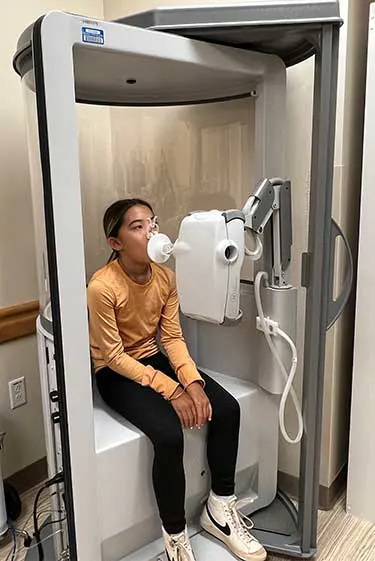
Image of child doing a breathing test.
Care at Pali Momi
The doctors at Pali Momi review, diagnose and treat breathing problems and lung diseases. We treat common issues like a long-lasting cough to more serious conditions like lung diseases.
The team works with other specialists to ensure all parts of a patient's condition are considered to develop a personalized care plan.
Lung Nodule Program at Pali Momi
Lung cancer is the leading cause of cancer-related death in Hawaiʻi and worldwide. Data also shows that lung cancer rates are higher in our Asian and Pacific Islander populations. Even individuals who have never smoked can still be at risk for developing lung cancer.
Lung nodules are small growths in the lungs that are often found during an X-ray or CT scan for something else. Most of the time, these nodules are benign or noncancerous. Even if a nodule is not cancerous, early diagnosis and tracking is important to detect or rule out cancer.
The Lung Nodule Program at Pali Momi aims to personalize care for patients with lung nodules. Our approach focuses on early detection and treatment of lung cancer.
Our goal is to provide evidence-based medical therapies to Central and West Oʻahu. With our cutting-edge Ion robotic bronchoscopy platform, we are able to biopsy lung nodules found along the perimeter of the lung. These nodules were previously inaccessible without surgery.
A Multidisciplinary Team
The Lung Nodule Program brings together a multidisciplinary team of specialists that includes:
- Pathologists
-
Pulmonologists
-
Oncologists
-
Radiologists
- Thoracic surgeons
Our pulmonologists are trained in advanced procedures and perform navigational bronchoscopies and endobronchial ultrasound-guided biopsies. These advanced procedures provide patients with biopsy and staging in lung cancer in one appointment.
We work closely with thoracic surgeons and oncologists if cancer is diagnosed. This expedites care and may assist with photodynamic therapy, brachytherapy and intraoperative marking of lesions.
Care at Straub Benioff
Respiratory health at Straub Benioff starts with your primary care provider (PCP). If you have concerns about your lung health, your PCP can connect you with pulmonary experts who can assess, diagnose and treat breathing disorders and lung disease.
Care at Wilcox
On the island of Kauaʻi, Wilcox provides expert care for a range of health issues affecting the lungs and chest. Many types of lung problems require clinical care by a physician or other healthcare professional.
Please consult with your primary care provider (PCP) about any concerns you may have about your lung health.
Our Care Locations
Oʻahu
Kapiʻolani Medical Center for Women & Children Kapiʻolani Medical Center for Women & Children
1319 Punahou St.
Honolulu, HI 96826
Phone: 808-983-6000
Get directions
Details
Kapi‘olani Pediatric Pulmonology & Sleep Medicine Clinic
Kapi‘olani Pediatric Pulmonology & Sleep Medicine Clinic
1401 S. Beretania Street
Suite 850
Honolulu, HI 96814
Phone: 808-373-7566
Get directions
Details
Pali Momi Medical Center
Kapiʻolani Medical Center for Women & Children
1319 Punahou St.
Honolulu, HI 96826
Phone: 808-983-6000
Get directions
Details
Kapi‘olani Pediatric Pulmonology & Sleep Medicine Clinic
Kapi‘olani Pediatric Pulmonology & Sleep Medicine Clinic
1401 S. Beretania Street
Suite 850
Honolulu, HI 96814
Phone: 808-373-7566
Get directions
Details
Pali Momi Medical Center
 Pali Momi Medical Center
98-1079 Moanalua Road
‘Aiea, HI 96701
Phone: 808-486-6000
Get directions
Details
Pali Momi Medical Center Pulmonology Clinic
Pali Momi Medical Center Pulmonology Clinic
98-1079 Moanalua Road
Suite 570
ʻAiea, HI 96701
Phone: 808-485-3085
Get directions
Details
Straub Benioff Medical Center
Pali Momi Medical Center
98-1079 Moanalua Road
‘Aiea, HI 96701
Phone: 808-486-6000
Get directions
Details
Pali Momi Medical Center Pulmonology Clinic
Pali Momi Medical Center Pulmonology Clinic
98-1079 Moanalua Road
Suite 570
ʻAiea, HI 96701
Phone: 808-485-3085
Get directions
Details
Straub Benioff Medical Center
 Straub Benioff Medical Center
888 S. King St.
Honolulu, HI 96813
Phone: 808-522-4000
Get directions
Details
Straub Benioff Medical Center – Hawaiʻi Kai Clinic
Straub Benioff Medical Center – Hawaiʻi Kai Clinic
Koko Marina Shopping Center
7192 Kalanianaʻole Highway, Suite A200
Honolulu, HI 96825
Phone: 808-396-6321
Get directions
Details
Straub Benioff Medical Center
888 S. King St.
Honolulu, HI 96813
Phone: 808-522-4000
Get directions
Details
Straub Benioff Medical Center – Hawaiʻi Kai Clinic
Straub Benioff Medical Center – Hawaiʻi Kai Clinic
Koko Marina Shopping Center
7192 Kalanianaʻole Highway, Suite A200
Honolulu, HI 96825
Phone: 808-396-6321
Get directions
Details
Kauaʻi
Wilcox Medical Center Wilcox Medical Center
3-3420 Kūhiō Highway
Līhu‘e, HI 96766
Phone: 808-245-1100
Get directions
Details
Wilcox Medical Center
3-3420 Kūhiō Highway
Līhu‘e, HI 96766
Phone: 808-245-1100
Get directions
Details