

[Music]
7 seconds
Stroke is the third leading cause of death here in Hawaiʻi and fifth across the nation. Michelle Sato is a nurse practitioner and the chief of advanced15 seconds
practice providers for Hawaiʻi Pacific Health Medical Group. She's here to talk about stroke awareness month. So let's start very basic, Michelle. What exactly22 seconds
is a stroke? So there are two main types of stroke. There are es schemic strokes where a clot blocks blood flow to the brain and there's hemorrhagic strokes or31 seconds
the bleeding type where a weakened blood vessel ruptures and leaks blood into the brain. And I know we typically think about our capuna and we we're concerned38 seconds
about them but but this could happen young or old. Right. Exactly. Strokes can happen to anyone regardless of age including kids. Women do have a higher47 seconds
risk of stroke than men. In fact, one in five women will have a stroke. Let's focus on prevention then. What causes a stroke? So there are some risk factors56 seconds
for stroke that we cannot control like ethnicity and our genetics. But up to 80% of strokes are actually preventable1 minute, 3 seconds
through things like lifestyle changes and stroke risk factor modification. So the things we can control are blood1 minute, 11 seconds
pressure which is actually the number one modifiable stroke risk factor, physical activity, obesity, diet,1 minute, 20 seconds
smoking or nicotine dependence, adequate sleep, and high cholesterol. And my understanding is is reacting quickly can1 minute, 28 seconds
do wonders as far as recovery. So So how do I know if someone in front of me is having a stroke? Exactly. Recognizing stroke is critical. And an easy way to1 minute, 36 seconds
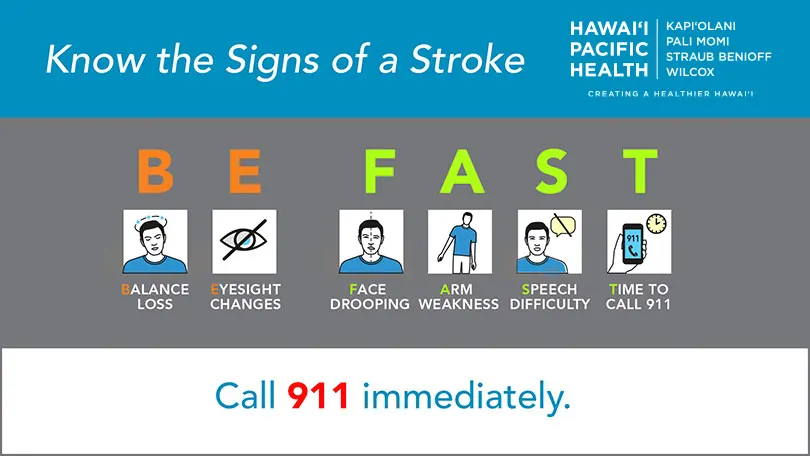
remember the signs of stroke is the acronym BAST. So the B in BAST is for balance. Someone having a stroke may suddenly become unsteady on their feet.1 minute, 47 seconds
E in BAST is for eyes. Someone could lose eyesight in one or both eyes. The F1 minute, 54 seconds
in BAST is for face. They may have face drooping on one side of their face. The A in BAS is for arm weakness or leg2 minutes, 2 seconds
weakness on one side of their body. An S in BAS is for speech changes. They may have slurred speech, difficulty getting2 minutes, 9 seconds
the words out, or difficulty understanding what's being said to them.2 minutes, 13 seconds
And if any of these symptoms occur, the T in be fast is for time. Stroke is a medical emergency and it's time to call2 minutes, 22 seconds
911 because every minute that's going by if you're having a stroke, you're losing millions of brain cells and the quicker2 minutes, 29 seconds
you get treated for stroke, the more likely you are to recover. Yeah. Okay.2 minutes, 33 seconds
So, before you go, can can can you explain to us what an advanced practice provider is? So, advanced practice providers consist of nurse practitioners, certified nurse andists,2 minutes, 43 seconds
and physician assistants. Hawaiʻi Pacific Health has nearly 200 advanced practice providers who partner with our2 minutes, 50 seconds
physicians in our physician-led team based care model. And we believe this partnership is key to providing highquality care to the community. Yeah.2 minutes, 59 seconds
All right, Michelle, thank you for joining us. We appreciate it. Thank you.3 minutes, 1 second
And thank you for helping to make this a healthier Hawaiʻi.

