

Partnering for a Healthier Hawaiʻi
At Hawaiʻi Pacific Health, we are committed to partnering with others in our community to create a healthier Hawaiʻi by investing in health where it starts – in our homes, schools, and jobs.
Health starts where we live, learn, work, and play. Often, this requires addressing needs beyond our traditional hospital walls.
Community benefit reportsHPH Place-Based Investments
HPH place-based investments focus on the social and economic conditions that shape health outcomes, like housing, food access, and financial stability.
Since 2023, HPH has invested $8.5 million into local community impact loan funds that create healthier communities by providing flexible, low-cost loan capital for affordable housing, sustainable food systems, and household economic empowerment.
Community Health Priorities
Partnering to Invest in Community Health
View transcript
MIKE ROBINSON: I want to talk about the great work HPH is doing in community engagement with our partners. This is our three-year strategic planning cycles in three areas. One is in sustaining healthy food systems here in Hawaiʻi. The second part is supporting affordable housing. The third piece is through workforce and opportunities for economic empowerment itself. The work that we've done with CNHA, Hawaiʻi Community Lending and Feed The Hunger, that's all part of our initiative on place-based investment and local investment that we've adopted through the Healthcare Anchor Network.
KEVIN BOYD: In regular life, you don't know where fo' get the help for build a house, you know, the money and all that kine stuff. It's one big challenge for everybody, I'm sure.
MIKE ROBINSON: We have to make these kind of investments and initiatives upfront because housing, the stress of not having to worry about finances, all of that, are certainly contributors to good health and wellness.
PATTY CHANG: How is an economy supposed to be healthy unless we are feeding ourselves nurturing ourselves and the community?
CLAIRE SULLIVAN: Food is central to making a healthier community. It means that you can be healthier in your own body. It also means that you can participate in a diversified and healthy economy.
PATTY CHANG: What Feed The Hunger Fund does, we provide loans and grants to support small food entrepreneurs in the islands.
CLAIRE SULLIVAN: Feed The Hunger Fund has been integral to FarmLink success. We would, it is no exaggeration to say, have died on the vine, without their support.
PATTY CHANG: So Hawaiʻi Pacific Health has been an amazing partner for us. They have contributed $1.5 million in loan capital.
KŪHIŌ LEWIS: So you have your big banks, you have your credit unions, and then you have us. And not too many people know that this type of lending exists, but it's community lending.
PETER COLOMBO: So Hawaiʻi Pacific Health and CNHA, thank you for believing in us, for giving a small young Hawaiian business owner an opportunity to stay in business.
KŪHIŌ LEWIS: Because everyone knows, that access to capital is how you grow. And so when you focus on the foundational elements that make one healthy, it really is economics. It's about having financial foundation to stand on. It's about having a place to sleep at night, because we're focusing on the things that are needed to make an overall healthy person.
JEFF GILBREATH: At Hawaiʻi Community Lending, we provide grants and loans to local families so that they can start on their path to affordable home ownership. And we focus on Native Hawaiians because Hawaiians have been shut out of the system for far too long.
MIKE ROBINSON:I feel like we're part of a movement now. There's so much conversation around regenerative tourism, regenerative agriculture. Well, this is regenerative capital.
JEFF GILBREATH: That is the power of being able to grow money that gets invested in us. It's the relationship that gets built that allows for that money to come back and allows us to lend to the next family so we can build community health and, and wealth.
KŪHIŌ LEWIS: When you help a family, you're actually helping a community.
KEVIN BOYD: What's good is the kids going to have some place to call their own later. That's the main thing.
JEFF GILBREATH: The Boyd ʻohana is a family from Kauaʻi that started on the path to home ownership and they thought it just wouldn't be possible. Kevin Boyd is a small business owner. He had to take on a bunch of debt during Covid to make things work. And so the first thing that we did when he came through our doors is we got him a debt consolidation loan that was funded by Hawaiʻi Pacific Health. It got his financials to a place where we could approve him for a mortgage loan. And so then we could also make a construction loan funded by Hawaiʻi Pacific Health. And once that health and that wealth is created for the family, they're more likely to share with others in their community.
KŪHIŌ LEWIS: That's what we want, is we want more families to be able to stay home. We should all collectively work towards keeping Hawaiʻi special.
JEFF GILBREATH: The future's bright and with investors like Hawaiʻi Pacific Health, we'll definitely sustain this work.
PATTY CHANG: And the resources that we are providing for them now is a stepping stone to all of the wonderful things that they can be doing in the future. That is the legacy.
KEVIN BOYD: As long as you get your own place to call your own is like, it's life-changing right there.
Community Health Priorities
Together, the community investments made by our loan fund partners have had a significant impact on increasing affordable housing, creating a more sustainable food system, and improving economic empowerment for asset-limited households.
By investing in these areas, we aim to strengthen families and develop resilient children.
Our Collective Impact (2023-2025)
Affordable Housing
Hawaiʻi faces a significant shortage of affordable housing. However, reports show that when a person has adequate and stable housing, they also have better physical and mental health, access to healthcare, and opportunities for social and economic advancement.
HPH invests in increasing access to affordable housing by providing financing for:
- Nonprofit developers of affordable housing.
- Low-cost mortgages for low-income homebuyers.
- Home construction for Native Hawaiians eligible to build on Hawaiian Homelands.
2023-2025 Impact
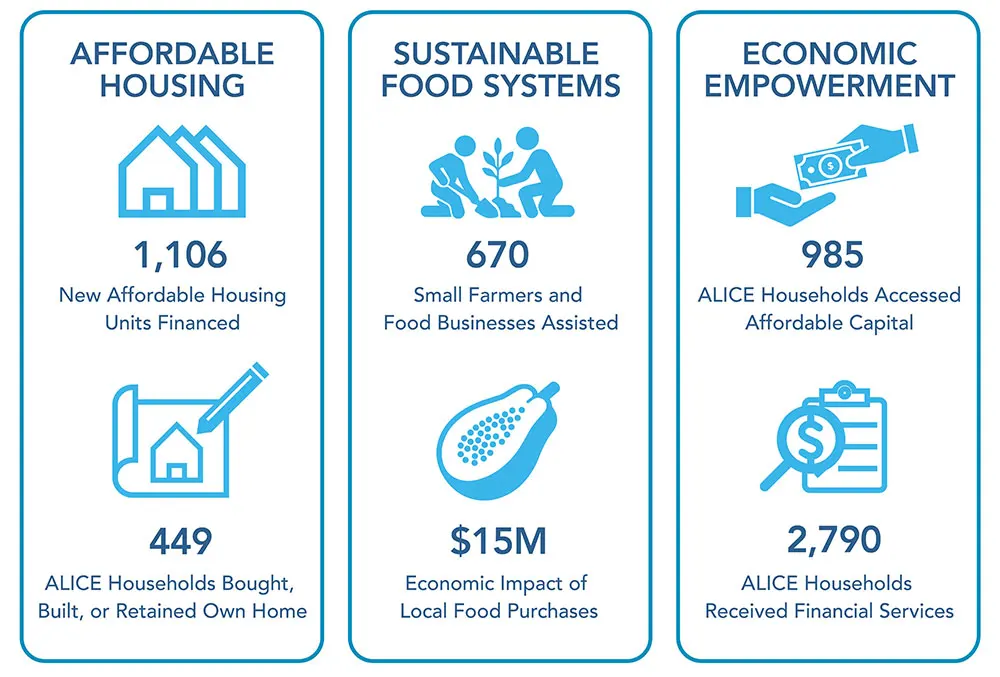
- 1,106 new affordable housing units were financed statewide.
- 449 low-income households bought, built, or retained their own homes.
Sustainable Food Systems
Strengthening Hawaiʻi’s food systems can improve food access for all residents. Providing our community healthier food choices that are locally produced addresses food insecurity and nutritional needs in ways that are culturally appropriate and sustainable.
HPH invests in a more sustainable food system by supporting:
- Access to capital, technical assistance, and markets for small farmers and food businesses. This assistance enables them to increase their revenues, build their assets, and grow their businesses for the future.
- Local food sourcing for HPH’s food services, which complements our food system investments by providing market access for – and directing HPH’s purchasing dollars to – small, local farmers, and food businesses.
2023-2025 Impact
- 670 small farmers and food businesses received free business consulting services, and 111 obtained affordable loan capital.
- HPH collaborated with Kamehameha Schools on local food sourcing. Collectively, the two systems’ local food purchases had an economic impact of more than $15 million.
Economic Empowerment
Access to capital is essential for households to improve their economic security and well-being. It empowers them to build assets, manage unexpected expenses, and invest in their futures.
HPH supports the economic empowerment of asset-limited households by investing in:
- Financial, housing, and employment counseling.
- Resources for credit repair, debt reduction, and housing retention.
- Access to capital to achieve homeownership.
2023-2025 Impact
- Nearly 3,000 households received assistance with financial literacy and housing counseling.
- Nearly 1,000 asset-limited households accessed affordable capital to build, buy, or retain their own homes, decrease debt, and increase assets.

